
National Logical Reasoning Olympiad Class 7
LOGICAL REASONING OLYMPIAD CLASS 7
The National Logical Reasoning Olympiad (NLRO) for Class 7 is designed to strengthen and refine students’ analytical thinking, logical reasoning, and problem-solving skills. Specifically developed for Class 7 learners, the syllabus includes topics such as number series, coding-decoding, spatial reasoning, analogies, classification, and practical reasoning scenarios. The Olympiad provides students with an opportunity to apply their observation and logic skills through Olympiad-style questions, boosting their confidence in solving a wide range of problems independently.
Crafted by experienced educators, the Class 7 NLRO workbook contains chapter-wise multiple-choice questions with clear explanations and detailed answers. Its structured and interactive format makes learning enjoyable while helping students build a solid foundation in logical reasoning.
PREPARATION MATERIAL FOR LOGICAL REASONING OLYMPIAD
Consistent and focused practice is key to performing well in the Class 7 NLRO. Engaging students in a variety of reasoning exercises enhances analytical thinking, observation, and problem-solving abilities. The specially designed Class 7 workbooks introduce topics in a step-by-step manner, gradually increasing in complexity to challenge and develop students’ critical thinking and logical skills. This structured approach ensures learners gain confidence and develop a systematic approach to tackling problems ahead of the Olympiad.
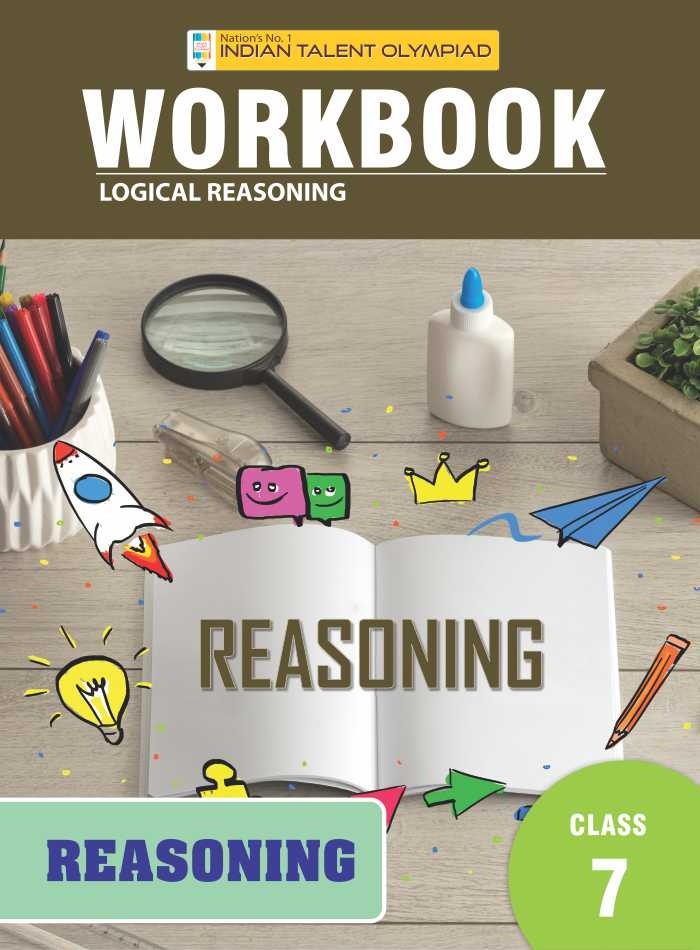
LOGICAL REASONING OLYMPIAD WORKBOOK CLASS 7
The Class 7 NLRO workbook is carefully developed to make problem-solving and critical thinking engaging and age-appropriate. It covers essential topics such as number series, coding-decoding, analogies, classification, spatial reasoning, and real-world reasoning problems. The workbook’s interactive exercises and clearly divided chapters guide students to master logical reasoning concepts progressively.
Parents and teachers can monitor the student’s progress effectively and familiarize themselves with the types of questions commonly found in the Olympiad. Participating in the NLRO enhances observation, sharpens reasoning skills, and builds confidence, empowering Class 7 students to approach challenges with creativity, focus and enthusiasm.
Logical Reasoning Books:
LOGICAL REASONING OLYMPIAD SYLLABUS FOR CLASS 7
The Class 7 NLRO syllabus is carefully designed to strengthen students’ logical thinking, analytical abilities, and problem-solving skills. Learners engage in exercises such as coding-decoding, analogy and classification, and blood relations, which enhance critical thinking and pattern recognition.
The syllabus further develops spatial and logical reasoning through direction sense tests, logical Venn diagrams, and a variety of puzzles. Students also practice mathematical operations and analytical reasoning to sharpen their numerical and logical skills.
In addition, topics like mirror and water images, embedded figures, figure formation including construction of squares, figure matrix, and ranking provide ample opportunities to apply reasoning in both visual and practical contexts. This comprehensive range of exercises ensures that students build strong observation skills and develop the ability to tackle complex problems effectively.
Consistent practice of these activities helps learners gain confidence, improve analytical thinking, and approach challenging questions systematically. The Class 7 NLRO workbook aligns closely with this syllabus, offering structured and engaging preparation material for the Olympiad. Parents can refer to the syllabus below to guide and support their child’s preparation.
Chapter 1: CODING-DECODING
Chapter 2: ANALOGY AND CLASSIFICATION
Chapter 3: CODING-DECODING
Chapter 4: BLOOD RELATIONS
Chapter 5: DIRECTION SENSE TEST
Chapter 6: LOGICAL VENN DIAGRAMS
Chapter 7: PUZZLE
Chapter 8: MATHEMATICAL OPERATIONS
Chapter 9: ANALYTICAL REASONING
Chapter 10: MIRROR & WATER IMAGES
Chapter 11: EMBEDDED FIGURES AND FIGURE FORMATION
Chapter 12: CONSTRUCTION OF SQUARES
Chapter 13: FIGURE MATRIX
Chapter 14: RANKING
Online Olympiad Registration | Olympiad Exam Registration 2026 | Apply for Olympiad Exam | Student Annual School Olympiad Registration | Olympiad Mock Test & Olympiad Trial Test | Online Olympiad | Olympiad Student Test | Online Olympiad Monthly Series | School Olympiad Brochure | Monthly Online Olympiad Brochure | Olympiad Exam Schedule | Monthly Online Olympiad Schedule | Olympiad 2026 Key Dates Schedule Exam Pattern and Benefit | School Olympiad Notice Board | Olympiad Exam Guidelines | How To Prepare For Olympiad Exam | Olympiad Meaning | Use of Olympiad Exams | Olympiad Results | Olympiad Sample Papers | Olympiad Exam Participation | Olympiad Downloads | Olympiad Exam Pattern | Monthly Olympiad Guidelines | Online Olympiad Exam Schedule | Last Date of Olympiad Registration | Monthly Olympiad Syllabus | How to become successful in Olympiad | Preparation Guide for Olympiad |