
National Logical Reasoning Olympiad Class 9
LOGICAL REASONING OLYMPIAD CLASS 9
The Class 9 National Logical Reasoning Olympiad (NLRO) is designed to further sharpen students’ reasoning power, analytical thinking, and problem-solving proficiency. Structured specifically for Class 9 learners, the syllabus introduces more advanced concepts such as complex number and alphabet series, coding–decoding, analogies, classification, spatial reasoning, and logical application in real-life situations. By working through Olympiad-style questions, students learn to apply logic systematically and develop confidence in handling challenging and unfamiliar problems independently.
Prepared by subject specialists, the Class 9 NLRO workbook features chapter-wise multiple-choice questions supported by clear answers and detailed explanations. Its well-planned layout and learner-friendly approach help students strengthen their logical reasoning skills while staying actively engaged in the learning process.
PREPARATION MATERIAL FOR LOGICAL REASONING OLYMPIAD
Strong performance in the Class 9 NLRO depends on regular practice and a focused study approach. Exposure to a wide variety of reasoning-based questions helps students refine critical thinking, accuracy, and analytical depth. Class 9–specific preparation workbooks present concepts in a structured and progressive manner, with increasing levels of difficulty to match students’ growing cognitive abilities. This methodical practice helps learners develop confidence, speed, and clarity before appearing for the Olympiad.
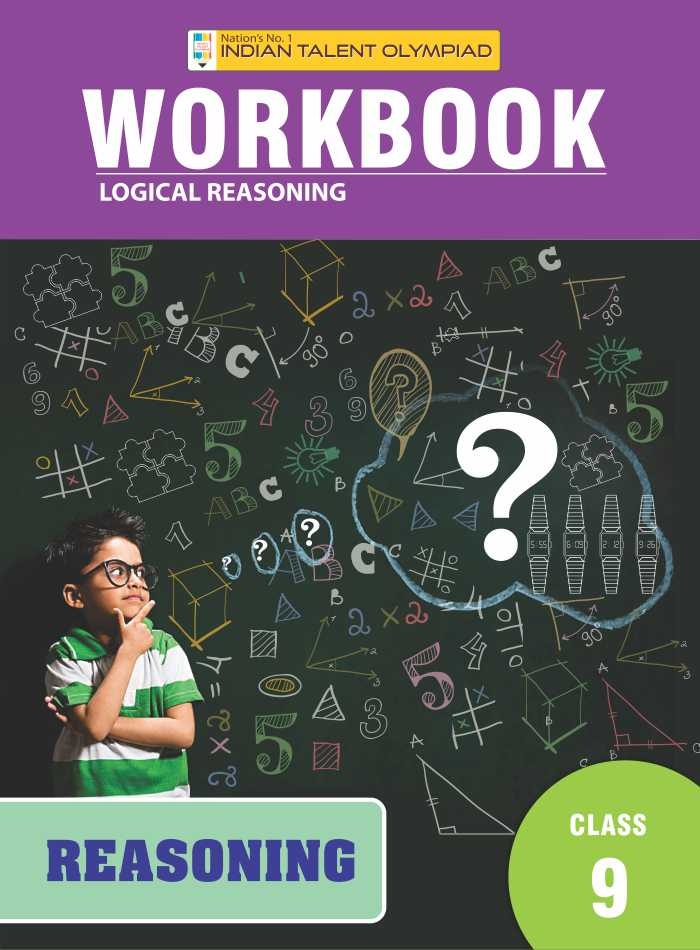
LOGICAL REASONING OLYMPIAD WORKBOOK CLASS 9
The Class 9 NLRO workbook is thoughtfully developed to encourage higher-order thinking and logical analysis at an age-appropriate level. It covers essential areas such as advanced series, coding–decoding, analogy and classification, spatial reasoning, and applied logic problems. Interactive exercises and clearly organized chapters allow students to build concepts step by step and strengthen their reasoning skills effectively.
Parents and teachers can use the workbook to monitor progress and gain insight into the Olympiad question pattern. Participation in the NLRO enhances logical aptitude, boosts confidence, and equips Class 9 students with the skills needed to approach complex problems with precision, curiosity, and confidence.
Logical Reasoning Books:
LOGICAL REASONING OLYMPIAD SYLLABUS FOR CLASS 9
The Class 9 NLRO syllabus is structured to strengthen higher-level logical reasoning, analytical thinking, and problem-solving skills. Students work on concepts such as series completion, alpha-numeric patterns, and inserting the missing character, which help sharpen observation, accuracy, and pattern identification.
Reasoning ability is further developed through topics like analogy, classification, coding–decoding, and blood relations, encouraging learners to apply logic and draw meaningful connections. The syllabus also includes puzzle tests, sequential output tracing, direction sense tests, and logical Venn diagrams, enabling students to think step by step and solve multi-layered problems systematically.
In addition, students practice alphabet tests, ranking, and mathematical operations to enhance both logical and numerical reasoning. Regular engagement with these well-planned topics helps learners improve analytical clarity, build confidence, and approach challenging questions with a structured mindset. The Class 9 NLRO workbook is aligned with this syllabus and provides organized, engaging practice for effective Olympiad preparation. Parents can refer to the syllabus provided below to guide and support their child’s preparation effectively.
Chapter 1: SERIES COMPLETION
Chapter 2: ALPHA NUMERIC
Chapter 3: ANALOGY
Chapter 4: CLASSIFICATION
Chapter 5: CODING-DECODING
Chapter 6: BLOOD RELATIONS
Chapter 7: PUZZLE TEST
Chapter 8: SEQUENTIAL OUTPUT TRACING
Chapter 9: DIRECTION SENSE TEST
Chapter 10: LOGICAL VENN DIAGRAMS
Chapter 11: ALPHABEST TEST
Chapter 12: RANKING
Chapter 13: MATHEMATICAL OPERATIONS
Chapter 14: INSERTING THE MISSING CHARACTER
Online Olympiad Registration | Olympiad Exam Registration 2026 | Apply for Olympiad Exam | Student Annual School Olympiad Registration | Olympiad Mock Test & Olympiad Trial Test | Online Olympiad | Olympiad Student Test | Online Olympiad Monthly Series | School Olympiad Brochure | Monthly Online Olympiad Brochure | Olympiad Exam Schedule | Monthly Online Olympiad Schedule | Olympiad 2026 Key Dates Schedule Exam Pattern and Benefit | School Olympiad Notice Board | Olympiad Exam Guidelines | How To Prepare For Olympiad Exam | Olympiad Meaning | Use of Olympiad Exams | Olympiad Results | Olympiad Sample Papers | Olympiad Exam Participation | Olympiad Downloads | Olympiad Exam Pattern | Monthly Olympiad Guidelines | Online Olympiad Exam Schedule | Last Date of Olympiad Registration | Monthly Olympiad Syllabus | How to become successful in Olympiad | Preparation Guide for Olympiad |